


A Guide to Ladder Inspection Courses for UK Workplaces
Ladder inspection courses are dedicated training programmes designed to teach your team how to properly examine and record the safety condition of ladders and stepladders. The goal is to create a competent person within your company who can confidently meet UK legal requirements, helping to prevent accidents before they happen. As a family-owned British business since 1972, we understand that keeping your team safe is your number one priority, and this guide is here to help.
Why Ladder Inspection Courses Are Essential For Your Business
It’s all too easy to get complacent about ladders. We see them everywhere—in warehouses, on construction sites, and tucked away in maintenance cupboards up and down the UK. But this familiarity can easily mask a very real danger. For any business where staff work at height, ensuring your ladders are safe isn't just a good idea—it's a legal requirement.
This is where a formal ladder inspection course becomes absolutely vital. It’s much more than a simple box-ticking exercise; it's a cornerstone of any solid health and safety system. The main driver behind this is the Work at Height Regulations 2005, a crucial piece of legislation that sets the rules for any work done above ground level in the UK.
To get a quick overview of why this training matters, let's break down the key points.
Ladder Inspection Training At a Glance
Here’s a snapshot of the regulations and reasons that make ladder inspection training a must-have for UK businesses.
| Aspect | Key Information |
|---|---|
| Primary Legislation | The Work at Height Regulations 2005 mandates that all work-at-height equipment must be inspected. |
| Key Requirement | Inspections must be carried out by a 'competent person' at suitable intervals. |
| Definition of 'Competent' | Someone with the necessary training, knowledge, and experience to spot faults and assess safety. |
| Demonstrating Compliance | A formal course provides documented proof of competency for regulators like the HSE. |
| Accident Prevention | Training helps identify subtle defects (cracks, wear) before they cause a catastrophic failure. |
This table neatly sums it up: the law demands it, and common sense supports it. A trained inspector is your first line of defence against preventable accidents.
The Role of a Competent Person
A core part of these regulations is the rule that all equipment for working at height must be properly inspected by a 'competent person'. But what does ‘competent’ actually mean in practice? It’s not just about having a quick look; it's about having the right training, knowledge, and hands-on experience to spot faults and make a sound judgment on whether a ladder is safe to use.
Enrolling an employee in an accredited ladder inspection course is the most direct and defensible way to appoint a 'competent person' in your organisation. It gives you clear, documented proof of their skills, which is essential for showing due diligence to regulators like the Health and Safety Executive (HSE).
Beyond Legal Compliance
While staying on the right side of the law is a big motivator, the benefits of professional training go much further. A properly trained inspector can spot the subtle signs of wear and tear—like hairline cracks, worn feet, or slightly bent stiles—long before they lead to a complete failure. This proactive approach drastically cuts the risk of accidents that could lead to serious injuries, operational downtime, and expensive legal battles.
The sheer number of ladders in use across the UK makes this formal training critical. NHS England statistics paint a stark picture, revealing an average of 7,723 hospital admissions annually from ladder falls, which accounted for over 22,300 bed days in 2021/22 alone. For any employer, these figures underline why formal inspection is a non-negotiable risk-control measure.
By investing in ladder inspection courses, you're not just ticking a legal box. You're investing in:
-
A stronger safety culture where your team feels valued and protected.
-
Reduced liability thanks to a documented system of inspection and maintenance.
-
The prevention of accidents that can disrupt your business and tarnish your reputation.
For a deeper look into what a formal check involves, you can explore our detailed guide on the inspection of ladders. Ultimately, this training turns a regulatory headache into a powerful tool for building a safer, more resilient business.
Meeting Your Legal Duties for Ladder Safety
Figuring out workplace safety rules can sometimes feel like wading through treacle, but when it comes to ladders, your legal duties are actually quite clear. The main piece of legislation you need to get your head around is the Work at Height Regulations 2005. This is the law that sets the standard for keeping people safe when they’re working off the ground, and it puts the responsibility squarely on employers to make sure their kit is up to scratch.
At the heart of it all is a simple but critical rule: all equipment used for working at height, which includes every single ladder and stepladder on your site, must be inspected at 'regular intervals' by a 'suitably competent person'. Getting these two phrases right is the key to staying compliant and, more importantly, protecting your team from nasty falls.
What Makes an Inspector 'Competent'?
So, what exactly does ‘suitably competent person’ mean? It's not just a case of asking the most experienced person on site to give a ladder a quick look over. The Health and Safety Executive (HSE) is clear that competence comes from the right mix of training, real-world knowledge, and practical experience. It’s about being able to spot faults accurately and make a sensible call on whether the equipment is safe to use.
This is exactly where proper, accredited ladder inspection courses come in. Going through a formal training programme is the most straightforward and defensible way to prove that someone is competent. It sends a clear message to regulators and insurance companies that you've taken your legal responsibilities seriously.
A certificate from a recognised provider is your proof. It shows your inspector has been professionally trained and assessed, taking all the guesswork out of the equation.
How Often Should You Inspect Ladders?
That other phrase, 'regular intervals', can also feel a bit vague. But don’t worry, industry best practice has established some solid guidelines based on how often a ladder gets used. While everyone should be doing a quick pre-use check every time they pick up a ladder, the formal, documented inspections follow a different schedule.
Here’s a simple way to think about it:
-
Frequent Use (Daily): If a ladder is out being used all the time, it needs a formal, documented inspection every three months.
-
Occasional Use (Weekly): For ladders that come out about once a week, an inspection every six months is the standard.
-
Infrequent Use (Monthly or less): Even if a ladder is rarely used, it must still have a formal inspection at least once a year.
On top of this, it's a legal must to carry out an immediate formal inspection after any incident that could have damaged a ladder’s integrity – like if it’s been dropped from a height or hit by a forklift.
The Importance of Keeping Records
A quick nod and a verbal "yeah, it's fine" from your inspector just doesn't cut it. The Work at Height Regulations demand a formal, written record of every inspection. This creates an audit trail that proves you’re on top of your equipment management.
Your inspection records are more than just bits of paper; they are legal documents. Each one needs to show the ladder’s unique ID, the inspection date, any problems found, what was done about them, and the signature of the competent person who did the check.
The easiest way to manage all this is by keeping an organised ladder register. Meticulous record-keeping is vital, and using a system like ladder inspection tags gives everyone an immediate visual sign of whether the equipment is safe to use.
The legal mandate is crystal clear. UK law, specifically Regulation 6 of the Work at Height Regulations 2005, demands that ladders are inspected at regular intervals by a suitably competent person. To help businesses meet this duty, the Ladder Association's 'LadderCard' scheme is a popular choice, training thousands of people annually. In 2023 alone, over 15,300 delegates attended courses, including dedicated Ladder & Stepladder Inspection training, to gain the necessary competence and help their employers fulfil their legal obligations.
To build on the knowledge from a formal course, having access to comprehensive ladder safety guidelines can provide your team with invaluable practical tips for their day-to-day work.
Choosing the Right Ladder Inspection Course for Your Team
Once you’ve decided to invest in training, the next step is figuring out which type of ladder inspection course is the best fit for your business. Not all courses are delivered in the same way, and the right choice depends on your team’s size, your operational schedule, and the specific skills you need to build.
Making a smart choice here ensures you get the maximum return on your investment, both in terms of safety and budget. The main options generally fall into three categories: traditional classroom courses, flexible online e-learning, and practical on-site training held at your own workplace. Each format comes with its own set of advantages and potential drawbacks.
Classroom-Based Training
This is the classic approach. Your team members travel to a dedicated training centre for a day of instruction. It’s a structured environment led by an expert instructor, offering a focused learning experience away from the distractions of the workplace.
The biggest benefit here is the direct interaction. Participants can ask questions in real-time, engage in group discussions, and learn from the experiences of others in the room. This format is particularly effective for those who learn best in a formal, guided setting. However, it does require travel and takes employees off-site for a full day, which can disrupt your operations.
On-Site Training at Your Premises
For many businesses, on-site training offers the perfect blend of convenience and relevance. A certified instructor comes to your location and delivers the course using your own facilities and, most importantly, your own ladders.
This approach is incredibly practical. Your team gets to learn how to inspect the exact equipment they use every single day, making the training immediately applicable. There’s no travel time or cost for your staff, and you can often schedule the course to minimise operational downtime. It’s an ideal solution for training a larger group of employees at once.
The hands-on element is a massive plus. Inspecting your own familiar ladders for faults is far more memorable than examining a generic set in a training centre.
E-Learning and Online Courses
Online ladder inspection courses have become increasingly popular due to their flexibility and accessibility. These digital modules allow employees to learn at their own pace, fitting the training around their work schedules. This makes them a great option for individuals or small teams where taking a full day out is difficult.
E-learning is especially good for covering the theoretical side of things—the regulations, the standards, and the key principles of inspection. However, its main limitation is the lack of hands-on practice.
While online courses are excellent for foundational knowledge, they can't fully replicate the experience of physically handling a ladder and identifying real-world defects under an instructor's guidance. For this reason, many companies opt for a blended approach, using e-learning for the theory and arranging a separate practical assessment.
The table below breaks down the pros and cons of each training format, helping you decide which route is best for your team.
Comparison of Ladder Inspection Course Formats
| Training Format | Best For | Pros | Cons |
|---|---|---|---|
| Classroom-Based | Individuals or small groups who thrive in structured, academic settings and can travel off-site. | - Direct interaction with an expert instructor. - Group discussions and shared learning. - Fewer workplace distractions. |
- Requires travel and associated costs. - Takes employees off-site for a full day. - Less tailored to your specific equipment. |
| On-Site | Businesses training multiple employees at once who want practical, relevant experience. | - Highly convenient with no staff travel. - Training uses your own equipment. - Can be scheduled to minimise disruption. - Often more cost-effective for groups. |
- Requires a suitable, quiet space on-site. - Can be more expensive for just one or two people. |
| E-Learning | Individuals needing maximum flexibility, or as a way to cover theoretical knowledge before a practical session. | - Learn at your own pace, anytime. - Very cost-effective for the theory. - Accessible from anywhere with an internet connection. |
- No hands-on practical element. - Lacks real-time instructor feedback. - Requires self-discipline from the learner. |
Ultimately, choosing the right format comes down to balancing your operational needs with your training goals.
The best format depends entirely on your specific circumstances. Consider your team's learning style, your budget, and how much operational disruption you can manage. For many, the targeted, practical nature of on-site training delivers the most value by directly addressing the equipment and environment your team works with every day.
What You Will Learn in a Ladder Inspection Course
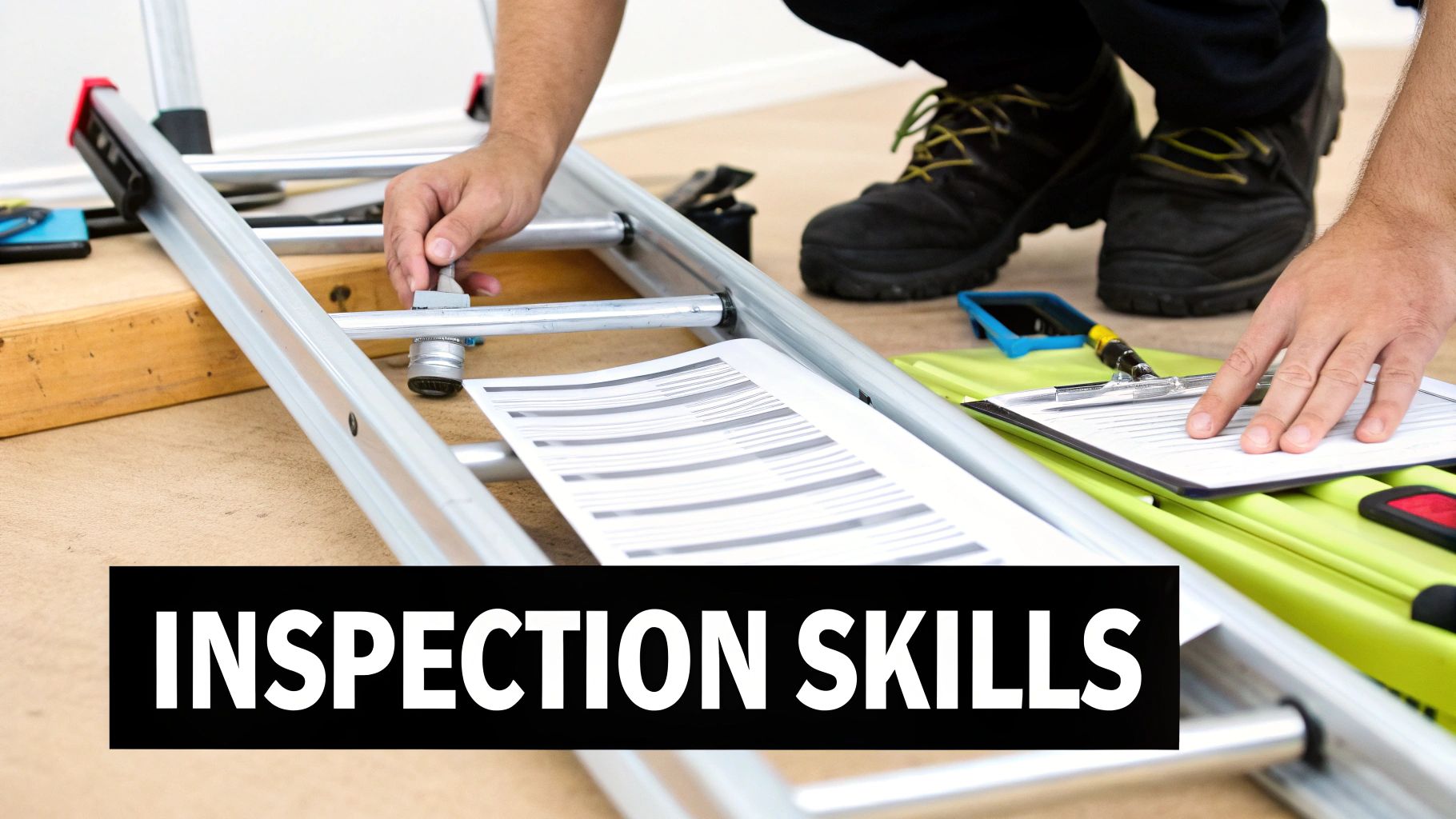
Ever wondered what actually goes on inside a ladder inspection course? It’s a lot more than just spotting a wobbly rung. A proper, professional course is a structured journey, designed to turn an employee into a competent inspector who has both the knowledge to spot hazards and the confidence to make safety-critical calls.
Let's pull back the curtain and walk through a typical syllabus. You'll see how the training builds logically, starting with the legal groundwork and finishing with practical, hands-on skills your team can use the very next day. It's about giving you a clear picture of the valuable, real-world competence your team will walk away with.
Understanding the Legal Framework
The first module of any decent course sets the scene. Before you can inspect a ladder, you need to understand why you're doing it. This part of the training is all about getting to grips with your legal duties, but in plain English, not legal jargon.
Delegates dive into the key legislation, mainly the Work at Height Regulations 2005. They'll learn what the law actually means by a "competent person" and "regular intervals," taking all the guesswork out of compliance. This foundation is crucial because it frames every inspection with a clear purpose: keeping people safe and the business on the right side of the law.
Differentiating Between Checks and Inspections
One of the most common points of confusion is the difference between a quick daily check and a formal inspection. A quality course makes this distinction crystal clear, as it’s fundamental to a solid safety system.
-
Pre-Use Checks: Trainees learn this is a quick, visual and tactile once-over that every single user must do before climbing a ladder. It's about spotting obvious, immediate dangers like a loose rung or visible crack. These checks are informal and don't need to be written down.
-
Formal Inspections: This is the main event. The course teaches a systematic, in-depth examination carried out by a competent person at scheduled times. Crucially, delegates learn that every formal inspection must be officially documented in a ladder register.
Getting this right empowers the whole workforce. While the inspector handles the formal process, everyone understands the importance of their own daily checks. After all, proper use is just as important as the inspection itself, and our guide to ladder etiquette explains how good habits contribute to overall site safety.
Mastering the Hands-On Inspection Process
This is where theory meets reality. The bulk of a good ladder inspection course is dedicated to teaching a methodical, repeatable inspection technique. Trainees are taught to examine every single component of a ladder, from top to bottom, leaving no stone unturned.
The core of the practical training is learning to see a ladder not as a single object, but as a system of interconnected parts. Each component—from the feet to the stiles, rungs, and locking mechanisms—has a specific function and a unique set of potential faults.
Trainees will learn how to spot a wide range of common (and not-so-common) defects that could lead to a catastrophic failure.
A Checklist of Common Ladder Defects
A competent inspector is trained to see issues that an untrained eye would easily miss. A typical course will give them hands-on experience identifying defects like:
-
Stiles and Rungs: Looking for cracks, splits, dents, bending, or excessive corrosion that weakens the ladder's main structure.
-
Feet and End Caps: Checking for worn, damaged, or missing feet, which are essential for preventing slips and providing a stable base.
-
Locking Mechanisms: On extension ladders, ensuring the locks engage securely and are free from damage or dirt that could cause them to fail.
-
Platform and Treads: For stepladders, checking for any bending, cracks, or loose rivets on the platform and steps.
-
Labels and Markings: Confirming that all safety labels, including the ladder's class (e.g., EN131 Professional) and safe working load, are present and legible.
By the end of the course, a delegate won't just know what to check; they'll understand how these defects compromise safety and what action to take, whether that’s taking it out of service immediately or scheduling a repair. This practical skill is the ultimate takeaway, turning a legal duty into a life-saving practice.
Supporting Compliance with the Right Equipment
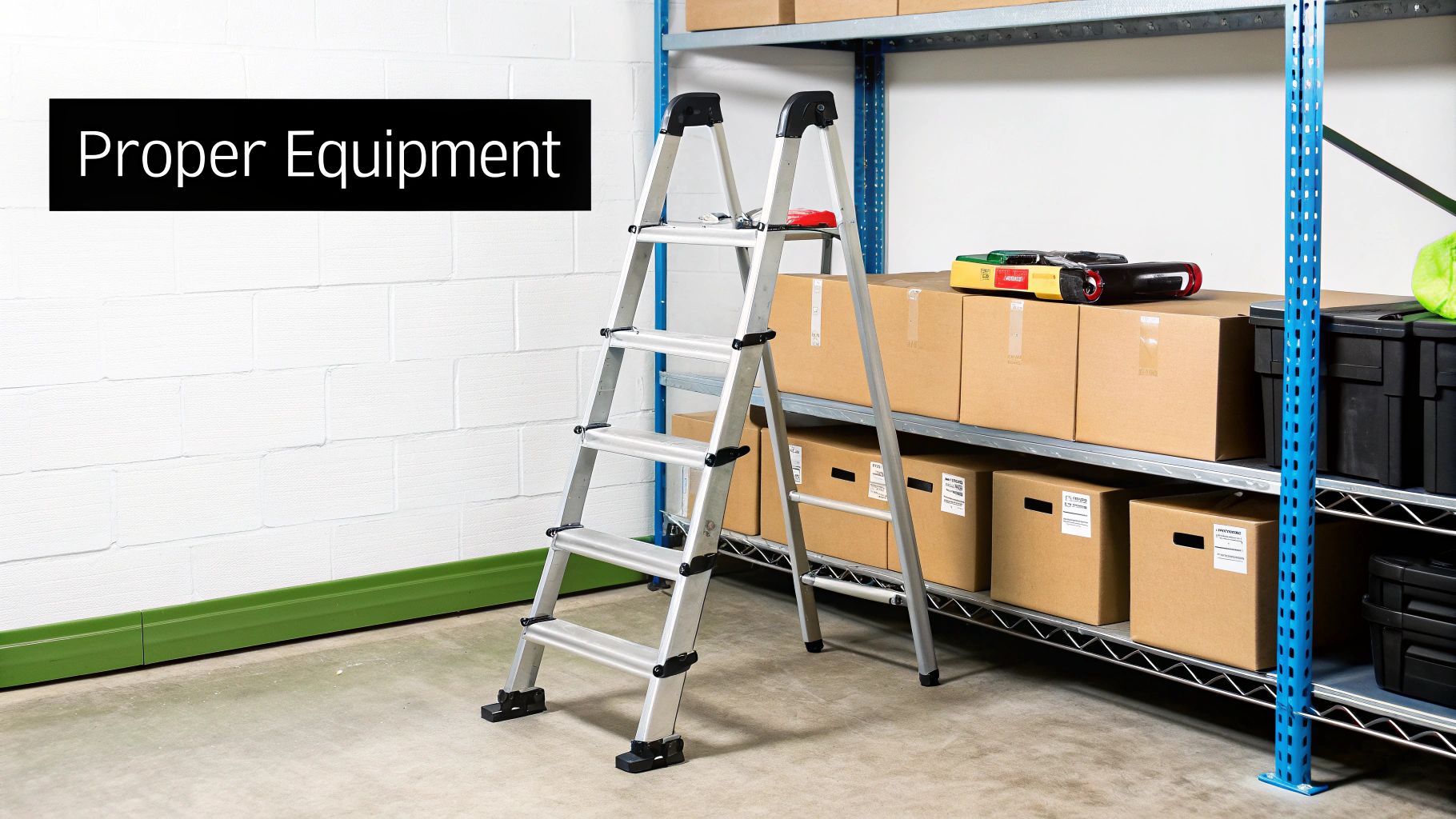
Sending someone on a ladder inspection course is the best way to get a competent inspector on your team. But their job becomes a lot easier—and your entire site becomes a whole lot safer—when you give them high-quality, durable equipment to work with from the start. It’s always better to be proactive about safety than reactive about maintenance.
Investing in the right ladder accessories isn’t just about ticking boxes; it makes passing those formal inspections a formality rather than a gamble. It's all about building a complete safety system where well-maintained ladders are backed up by accessories designed to stop the very damage an inspector is trained to spot.
Preventing Damage Before It Happens
One of the biggest culprits of ladder damage is instability, especially when you’re working on soft or uneven ground. Think about a ladder used day after day on a soft lawn, a gravel drive, or a sloping path. Over time, that instability can cause gradual damage to its feet and stiles – subtle issues that an inspector will rightly flag as a serious safety risk.
This is where having the right preventative gear makes a massive difference. High-quality, British-made accessories are built to tackle these exact problems at the source, protecting your investment and making sure your ladders stay in a safe, inspectable condition for much longer.
A competent inspector is trained to spot wear and tear on ladder feet and stiles caused by unstable ground. Using the right stabilising equipment from the outset can prevent this damage from ever occurring, extending the ladder’s service life and ensuring it passes inspection.
Essential Accessories for a Safer System
Creating a robust safety culture means thinking beyond just the ladder itself. You have to consider how your ladders are used, transported, and stored day-to-day. The right accessories not only make things safer for the user but also protect the equipment from damage and misuse between formal checks.
Consider adding these key items to your safety inventory:
-
Ladder Stabilisers: These are an absolute must for anyone working on soft or uneven ground. By spreading the ladder's weight over a larger, more stable base, they stop the feet from sinking into grass or shifting on gravel. This prevents damage before it even begins and gives the user a much safer footing. Our purpose-built ladder stabiliser legs are a perfect example of British-made quality designed for exactly this task.
-
Ladder Spurs: When working on hard, smooth surfaces like concrete or tarmac, spurs provide that critical extra grip. They dig in just enough to stop the base of the ladder from slipping outwards, which is one of the most common causes of ladder-related falls.
-
Anti-Climb Guards and Secure Storage: A surprising amount of damage happens when ladders aren't even being used. Storing them incorrectly can lead to warping or impact damage, while unauthorised use is a huge liability. Lockable anti-climb guards stop misuse in its tracks, and dedicated storage brackets ensure ladders are kept correctly, protecting them from the weather and accidental bumps.
By equipping your team with these tools, you’re actively putting the principles taught in ladder inspection courses into practice. You create an environment where equipment is protected, users are safer, and the inspector’s job becomes about routine checks rather than documenting preventable damage. It’s a smart, cost-effective way to show you’re serious about workplace safety.
Your Ladder Inspection Questions Answered
Even with the essentials covered, you'll likely still have a few questions bubbling up as you figure out the best approach to ladder safety for your team. To help you nail down your plans, we’ve put together some straightforward answers to the questions we hear most often from businesses across the UK about ladder inspection courses and staying compliant.
How Often Do Ladders Need a Formal Inspection in the UK?
The Work at Height Regulations 2005 are a bit vague, simply stating inspections should happen at 'suitable intervals'. Thankfully, industry best practice gives us a much clearer, more practical schedule. How often you need to carry out a formal, documented inspection really comes down to how frequently the ladder gets used.
Here’s a simple breakdown:
-
Daily Use: If a ladder is in action every day, it needs a formal inspection every three months.
-
Weekly Use: For ladders that come out less often, say once a week, an inspection every six months is the accepted standard.
-
Infrequent Use: Even if a ladder is only used monthly or less, it still needs a formal check-up at least once every year.
And remember, a formal inspection is an absolute must after any event that could have compromised the ladder's safety. Think things like being dropped from a height, getting hit by a vehicle, or being too close to a fire.
Who Qualifies as a Competent Person to Inspect a Ladder?
The term 'competent person' can sound a bit woolly, but the Health and Safety Executive (HSE) has a clear definition. It’s someone who has the right mix of training, knowledge, and hands-on experience to spot faults and make reliable judgements about safety.
While experience on the tools is valuable, the surest way to prove competence – and the one that will stand up to scrutiny – is through accredited training. A certificate from a recognised body, like one aligned with the Ladder Association, is your official proof that an individual has been professionally assessed. This piece of paper is vital for showing you've done your due diligence and protecting your business if an incident ever occurs.
What Is the Difference Between a Pre-Use Check and a Formal Inspection?
It's absolutely crucial that everyone on your team understands the difference between these two safety actions. They have very different jobs.
A pre-use check is the quick, informal look-over that the user must do before every single use. This is all about spotting obvious damage – a cracked stile, a wobbly rung, a missing foot. This check doesn't need to be written down.
A formal inspection is a much more detailed, systematic examination done by a trained, competent person at those scheduled intervals we just talked about. This deep dive has to be officially recorded in a ladder register, logging the ladder's unique ID, the date, the findings, and the inspector's name. This formal record is a key legal requirement.
Are Online Ladder Inspection Courses as Effective as In-Person Training?
This is a great question, and the honest answer is that both formats have their strengths. The best choice often depends on your team’s specific needs, and they can work brilliantly together.
Online ladder inspection courses are fantastic for getting the theory across. They're a cost-effective and flexible way for a large team to get up to speed on the laws, standards, and inspection criteria, all at their own pace.
But, and it's a big but, an online course can't replace the hands-on learning you get from an in-person session. There's nothing quite like physically handling different ladders, finding real defects, and having an expert instructor guide you through it. That’s where real confidence and competence are built.
For many businesses, a blended approach is the most effective. Use the online modules to lay a solid theoretical foundation, then follow up with a practical, in-person assessment to cement those crucial hands-on skills. This way, you can be sure your team isn't just knowledgeable, but truly capable of keeping your workplace safe and compliant.
At Bison Products, we are committed to supporting your safety culture with British-made equipment you can trust. As a family business since 1972, we've built our reputation on quality and reliability. From ladder stabilisers that prevent damage to secure storage that protects your assets, our products are designed to make compliance simpler. Explore our full range of safety and security solutions today.
Find out more about our UK-made safety equipment at https://www.bisonproducts.co.uk