

Your Practical Guide to HSE Working at Height Regulations
The HSE working at height regulations aren't just bureaucratic red tape; they are a vital framework designed with one clear goal: to prevent death and serious injury from falls in the workplace. This isn't just about high-rise scaffolding. As a family-owned UK business focused on site safety since 1972, we want to make it clear that these rules cover any task where a fall could cause harm. Think of a roofer on a new build, a shop assistant on a kick stool, or a caretaker changing a lightbulb on a small stepladder.
What is Working at Height and Who Do the Rules Apply To?
When you hear “working at height,” it’s easy to picture huge construction sites. While that’s part of it, the Health and Safety Executive (HSE) has a much broader definition. In simple terms, working at height is any situation where, if precautions aren't taken, a person could fall a distance likely to cause personal injury.
This straightforward definition means the regulations cover a surprisingly wide range of everyday tasks across countless UK industries. It’s a common myth that the rules only kick in above a certain height, but that’s not true. A fall from a low stepladder can be just as dangerous as one from a roof if the landing surface is hazardous.
Understanding the Scope of the Regulations
The rules don't just apply to the person doing the climbing. They place a legal duty on employers, the self-employed, and anyone who controls the work of others—like facilities managers or property owners hiring contractors. This creates a clear chain of responsibility to ensure safety is always the top priority.
The Work at Height Regulations 2005 were brought in to unify safety standards across all UK industries, and they impact an estimated 10 million workers every year. These regulations make sure that anyone responsible properly plans and organises the work, ensuring it's carried out by competent people using the right equipment. You can find more essential insights on these safety rules at britsafe.org.
So, who is actually covered? In short, everyone involved in the process.
Key Duties Under the Work at Height Regulations
The regulations clearly outline who is responsible for safety. This isn’t about pointing fingers; it’s about making sure everyone understands their role in preventing accidents. The table below breaks down the core duties for the main groups involved.
| Duty Holder | Core Responsibility |
|---|---|
| Employers | You are legally responsible for the health and safety of your employees. This includes providing proper training, equipment, and safe systems of work. |
| Self-Employed Professionals | You have the same responsibilities for your own safety as an employer does for their staff. You are your own safety manager. |
| Facilities/Building Managers | You have a duty to ensure that any contractors working on your premises are competent and that the work is carried out safely. |
Essentially, if you are involved in organising, managing, or carrying out work at height, you have a legal duty to get it right.
This guide is designed to be your practical toolkit. We’ll help you move beyond the legal jargon to understand exactly what your obligations are and how you can create a safer environment for everyone.
Understanding Your Legal Responsibilities
It’s easy to think the HSE working at height regulations are just for big construction firms with massive scaffolding rigs. The truth is, they reach much further, affecting almost every kind of business and property manager in the UK. Getting to grips with where the legal responsibility lies is the first, most crucial step in keeping everyone safe.
This responsibility is often called a 'duty of care' – a legal obligation you have to ensure the safety and well-being of others. This isn't just a corporate buzzword; it's a specific requirement that creates a chain of shared responsibility among a wide range of people and organisations.
Who Holds the Duty of Care?
The regulations make it very clear that responsibility isn’t down to one single person. Instead, it’s shared among everyone involved in the work. Think of it as a team effort, where every member has a distinct role to play in stopping accidents before they happen.
There are three main groups with legal duties:
-
Employers: They carry the main responsibility for keeping their employees safe. This means making sure any work at height is properly planned, supervised, and carried out by competent people who have the right, well-maintained equipment for the job.
-
The Self-Employed: If you work for yourself, you legally wear two hats: you're both the employer and the employee. You have the exact same duties as an employer, making you responsible for your own safety and that of anyone else who might be affected by your work.
-
Controllers of Work: This category is for anyone who controls the work of others, like a facilities manager hiring a contractor to fix the roof. They have a duty to ensure the contractor they bring in is competent and has a safe plan of action.
Practical Scenarios of Responsibility
To paint a clearer picture, let's look at a few everyday examples where these legal responsibilities come into play.
Picture a self-employed electrician on a ladder, fixing a security light on someone's house. It's on them to make sure their ladder is in good nick and is the right tool for the task. You can find out more about what this involves in our guide to effective ladder inspection training.
Now, think about a school caretaker clearing leaves from a low, single-storey gutter. The school, as the employer, is on the hook for providing the correct equipment and making sure the caretaker knows how to use it safely, even for a job that seems simple.
A crucial part of your legal responsibilities is ensuring all safety equipment is up to standard and compliant. For more complex structures, this might even require professional roof anchor testing, verification, and inspection services.
Finally, imagine a facilities manager for an office block hiring an outside company to clean the building’s windows. That manager's legal duty is to take reasonable steps to pick a contractor who knows what they're doing when it comes to safety. This means checking their safety procedures and making sure they have a solid plan before a single squeegee touches the glass.
In every single one of these cases, the regulations demand a proactive approach. It's not good enough to just react after an accident has already happened. The law insists that risks are identified and managed before anyone even thinks about leaving the ground. This shared responsibility ensures safety is considered from every angle, from the person on the ladder to the manager who hired them.
The Hierarchy of Control: Your Three-Step Safety Plan
If there’s one thing you absolutely must understand about the HSE Working at Height Regulations, it’s the hierarchy of control. This isn't just a bit of friendly advice; it's the core logic the HSE demands you follow whenever a job involves leaving the ground. Think of it like a safety pyramid: you always start at the top with the safest option and only move down to the riskier levels when you have no other choice.
The whole idea is simple, really. It’s always better to get rid of a hazard completely than to just manage the risk of someone getting hurt by it. Each step you take down that pyramid is a less effective, and therefore less desirable, way of keeping people safe.
Level 1: Avoid Working at Height Altogether
Right at the top of the pyramid, and your first legal duty, is to avoid working at height in the first place. Before anyone even thinks about grabbing a ladder or planning scaffolding, the question has to be: "Can we get this job done safely from the ground?"
It sounds obvious, but you’d be surprised how often this step gets skipped in the rush to get started. It forces a mental shift from "how do we work up there?" to "do we really need to be up there at all?"
For example, using long-reach poles for painting or cleaning can completely remove the need for a ladder. Thinking about practical solutions, like using safe, ladder-free methods for cleaning second-story windows, shows exactly how this first step can eliminate the risk of a fall entirely.
Level 2: Prevent a Fall from Occurring
If avoiding the work just isn't reasonably practicable, you have to move to the next level down: preventing a fall. This stage is all about creating a secure working platform that makes it impossible for someone to fall in the first place.
This is where "collective protection" comes into play – solutions that protect the whole team, not just one person wearing a harness.
-
Using Existing Safe Places: Can the work be done from a balcony or through a window that already has permanent, solid guardrails?
-
Installing Collective Equipment: If there's no safe place already there, the next best thing is to bring in equipment like a mobile elevating work platform (MEWP) or to put up proper scaffolding with double guardrails and toeboards.
The crucial point here is that the equipment itself is the main safety barrier. It physically stops a person from going over the edge.
Level 3: Minimise the Consequences of a Fall
You should only ever get to this final level once you've tried everything to avoid the work and prevent a fall. This step is about minimising the distance and consequences if a fall does happen. It's the least preferred option because you're accepting that a fall could occur and are just trying to soften the landing.
This is the point where you rely on personal fall protection equipment.
This final stage is a last resort, not a starting point. Relying on this level without first considering the higher levels is a common failure in risk assessment and a clear breach of the regulations.
Examples of equipment at this level include:
-
Safety nets and soft landing systems: These are set up below the work area to catch a worker if they fall, cushioning the impact.
-
Personal fall arrest systems: This involves wearing harnesses and lanyards that are clipped onto a secure anchor point.
This is also where high-quality ladder accessories, like our British-made ladder stabilisers, play a vital role. While a ladder itself doesn’t prevent a fall like scaffolding does, using stabilisers to secure it properly makes it far safer. This makes it a crucial tool for reducing risk when the higher-level controls just aren't feasible.
How to Conduct a Work at Height Risk Assessment
The term "risk assessment" might bring to mind clipboards and formal qualifications, but it's really just a structured way of thinking before you act. The HSE working at height regulations make it a requirement for a simple reason: it's the single most effective way to stop accidents before they happen.
At its heart, a risk assessment is just a careful look at what could genuinely hurt people. It allows you to step back and ask, "Have we done enough to prevent that harm, or could we do more?" It’s the absolute foundation of keeping people safe.
For experienced tradespeople, this process is often second nature, even if you don't use the official jargon. It’s that quick scan for overhead power lines before you pitch a ladder, or the boot test you give the ground to check it’s firm. For a facilities manager, it becomes a more formal job of spotting hazards like fragile skylights long before a contractor sets foot on site.
Step 1: Identify the Hazards
First things first, walk the job site. Your goal is simple: look for anything that could realistically cause harm. This isn't about imagining far-fetched scenarios; it's about using your eyes, common sense, and experience.
Keep an eye out for common culprits like:
-
Uneven or soft ground that could make a ladder or scaffold tower wobble.
-
Fragile surfaces, such as old roof panels, skylights, or brittle cement sheets that would never support a person's weight.
-
Overhead obstructions like power cables, low-hanging tree branches, or building overhangs.
-
Bad weather, including gusting winds, rain, or ice that can turn any surface into a skid pan.
Step 2: Decide Who Might Be Harmed and How
Now, shift your focus to the people. It’s a huge mistake to only think about the person performing the task.
You need to consider everyone who could be in the firing line, including:
-
The operative actually working at height.
-
Other workers on the ground who could be hit by falling tools or materials.
-
Members of the public, like a pedestrian who might walk underneath the work area without realising the danger.
Think specifically about how they could get hurt. A fall is the obvious one, but don't forget injuries from dropped objects or even electrocution from contact with live wires.
Step 3: Evaluate the Risks and Decide on Precautions
This is where your hazard-spotting connects back to the hierarchy of control. You've found the problems; now, what are you going to do about them? Ask yourself if the precautions you have in place are good enough, or if you need to step things up.
For instance, if the ground is soft, the solution might be using spreader plates under the feet of your ladder or scaffold. If you’ve spotted those fragile roof lights, you must either use crawling boards to distribute the weight or install guardrails to make them no-go zones. This is where quality kit, like our ladder stabilisers, becomes a vital part of your safety plan.
The aim is always to make the risk as low as is ‘reasonably practicable’. This doesn’t mean you have to eliminate every single risk imaginable, but you absolutely must take sensible, proportionate steps to protect people.
Step 4: Record and Implement Your Findings
If you employ five or more people, the law says you must write down your significant findings. Honestly, though, it's just good practice for everyone. A written record isn't just a tick-box exercise; it's your plan of action.
Your record should clearly show that you’ve:
-
Carried out a proper check of the site.
-
Figured out who might be affected.
-
Addressed all the obvious and significant hazards.
-
Made sure the precautions are reasonable and the remaining risk is minimal.
Think of it as a communication tool. It gets everyone on the same page and ensures nothing gets missed.
Step 5: Review and Update as Necessary
A risk assessment isn't a "one-and-done" document you can file and forget. Workplaces are dynamic, and so are the risks.
You need to review your assessment regularly to make sure it’s still relevant. If anything significant changes – you get new equipment, alter a work process, or have a near-miss incident – that’s your trigger for an immediate review. Part of this is also making sure your gear is still in safe working order. Our guide on ladder inspection tags provides some great pointers on how to manage that process properly.
Choosing the Right Equipment and People
Even the most watertight risk assessment is just paper. When it comes to the HSE working at height regulations, safety on the ground (and above it) boils down to two things: the right people using the right equipment.
Get either of those wrong, and you’re not just increasing risk; you’re practically inviting a serious incident. This is where the plan meets reality.
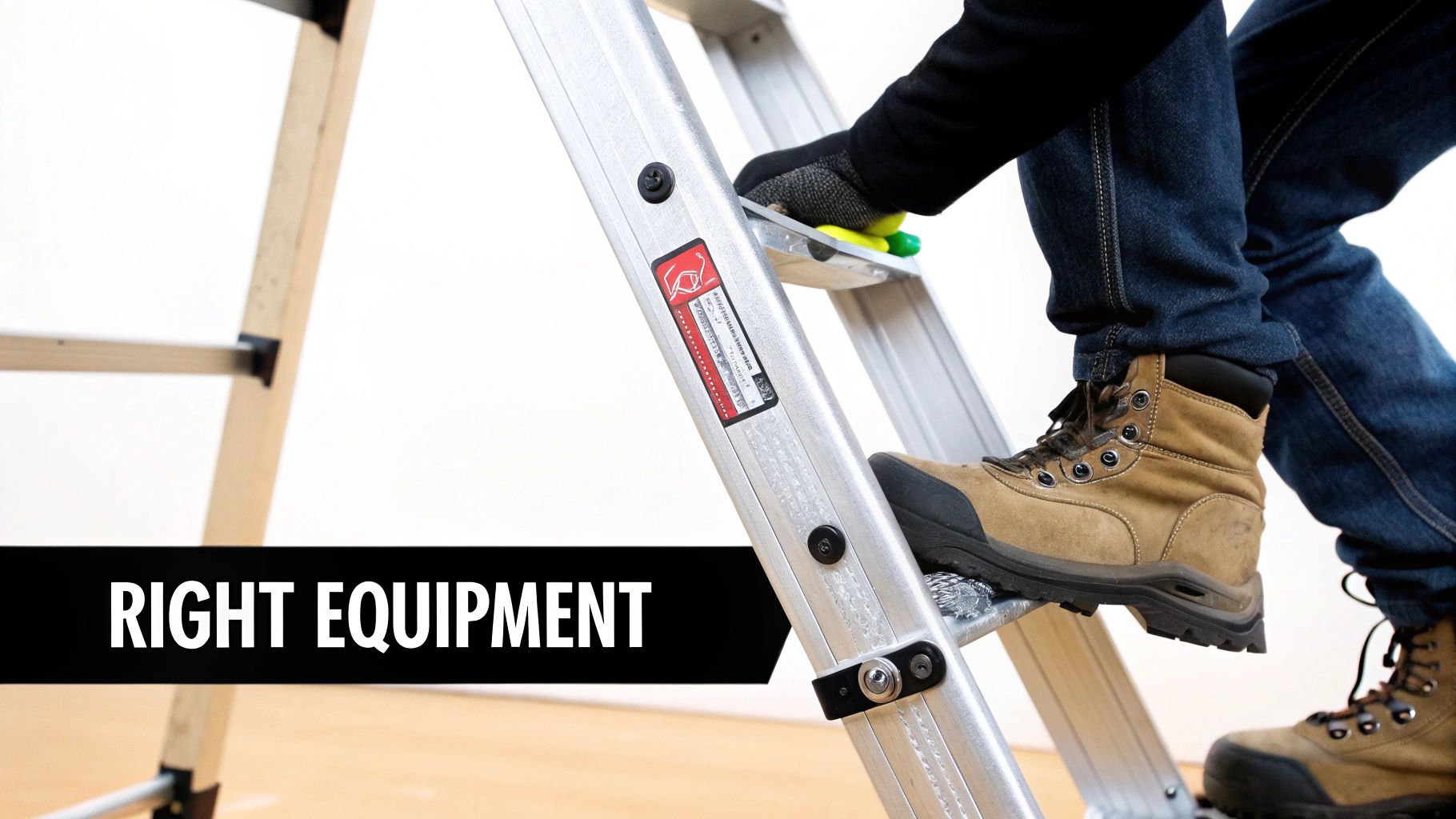
As a UK business that’s put workplace safety first since 1972, we’ve seen it all. We know that skilled operators and quality gear are the twin pillars of a safe site. One without the other just won't cut it.
What Makes a Person Competent?
You’ll see the word 'competent' a lot in HSE guidance, and it’s not just jargon—it has a specific legal weight. A competent person is someone with the right blend of skills, knowledge, and hands-on experience to do a job safely. This applies to everyone, from the person climbing the ladder to the supervisor who planned the work.
This doesn't always mean a pocketful of certificates, though formal qualifications certainly help. Competence is about practical, real-world ability and a sharp awareness of the risks. An experienced roofer who can spot a fragile roof tile from the ground and instinctively knows how to use their harness is competent. An office worker handed a ladder and told to change a lightbulb in a high ceiling is not.
It is the employer's absolute duty to ensure that anyone they ask to work at height is competent for that specific task. A failure to do so is a clear breach of the regulations.
Selecting the Correct Equipment
Once you have the right person for the job, they need the right tools. The equipment you choose has to be suitable for the task, the environment, and how long the work will take. Using a stepladder for a job that really needs a scaffold tower is a classic shortcut that ends in an accident report.
When picking your equipment, you need to think about a few key things:
-
Task Duration: Is this a quick five-minute fix, or will someone be up there for hours? Longer jobs often demand more stable platforms like scaffolding.
-
Working Conditions: Are you on soft ground, a sloping roof, or in a windy, exposed location? Each scenario requires a different solution to guarantee stability.
-
Potential Hazards: Are there fragile surfaces to avoid or overhead power lines to navigate? Your equipment must help manage these specific dangers.
This is where investing in solid, reliable gear pays for itself. For example, using our tough, British-made ladder stabilisers on uneven ground provides the kind of stability and confidence that worn-out or flimsy accessories simply can't offer. To dig deeper into choosing the right gear, have a look at our detailed guide on working at height safety equipment.
The Mandate for Inspection and Maintenance
Choosing the right kit is just step one. The law is very clear that all equipment for working at height must be properly inspected and maintained so it stays safe to use. This isn't a suggestion; it's a legal requirement.
Generally, inspections are broken down into three types:
-
Pre-use checks: A quick visual once-over done by the user every single time before they use the equipment. Think checking for dents, cracks, or missing feet.
-
Formal inspections: Detailed inspections carried out by a competent person at set intervals (often every 3-6 months), with a proper record kept.
-
Post-incident inspections: A thorough examination after any event that might have caused damage, like a ladder being dropped from a height.
This commitment to maintenance is something we build into our own products. By manufacturing quality gear designed to last and backing it with a 2-year warranty, we help you protect your team, your business, and your compliance record.
The Consequences of Non-Compliance
Right, let's talk about what happens when working at height goes wrong. It’s easy to think of the HSE regulations as just more red tape, but ignoring them has serious, real-world consequences. This isn't just about ticking boxes; it's about preventing life-changing injuries and even death. Getting this wrong has a cost, and it’s often tragic.
The kinds of mistakes that lead to accidents often seem small in the moment. A roofer stretching just that little bit further to save moving the ladder. A painter using a stepladder with a dodgy foot because it’s the only one in the van. Setting up scaffolding on soft, muddy ground after a bit of rain. These are the everyday shortcuts that can, and do, end in disaster.
The Human Toll of Falls from Height
The numbers really bring home the reality of the situation. Falls from height are still the single biggest killer in UK workplaces. In the 2023-2024 reporting period, out of 138 workers who lost their lives on the job, a shocking 50 deaths were caused by a fall from height.
That’s 36 percent of all workplace fatalities—a devastating figure, especially when you consider most of these incidents were preventable. What’s even more concerning is that this was a 25 percent increase on the previous year, showing we absolutely can't afford to get complacent. For a deeper dive into these figures, you can find more data on workplace incidents at altussafety.com.
Behind every one of those numbers is a person who didn't make it home to their family. They are electricians, builders, and maintenance staff. This is the ultimate price of non-compliance, and it’s a stark reminder of the responsibility that rests on anyone in charge of a site.
Financial and Legal Consequences
Aside from the devastating human impact, the financial and legal fallout for breaking the rules can be enough to sink a business. The HSE has real teeth and isn't afraid to act when they see people's lives being put on the line.
This screenshot from the official HSE website lays out the core duties for employers in black and white.
It couldn't be clearer: failing to plan, supervise, or provide the right gear is a direct breach of the law.
When the HSE gets involved, their actions can take a few different forms:
-
Improvement Notices: This is a formal, legal order to fix a specific problem within a deadline.
-
Prohibition Notices: If an inspector sees a risk of serious injury, they can issue one of these on the spot. It means all work must stop immediately, bringing your project to a grinding halt.
-
Prosecution: For the worst breaches, particularly those that cause injury or death, the HSE will take you to court. This can result in massive, unlimited fines and even prison time for individuals.
The fines are deliberately hefty. They're often calculated based on a company's turnover and can easily reach hundreds of thousands of pounds, even if no one was actually hurt.
The pain doesn't stop with the fine, either. A conviction leaves your company with a criminal record, makes your insurance premiums skyrocket, and can destroy your reputation overnight. Forget about winning new contracts, especially for public sector work. The truth is, investing properly in safety training and equipment costs a tiny fraction of what a single incident will set you back. This is about more than just avoiding a penalty; it’s about protecting people and ensuring your business has a future.
Common Questions About Working at Height Regulations
Once you get to grips with the main principles of the HSE working at height regulations, you often find yourself with practical, everyday questions. It’s one thing to know the rules, but another to apply them in specific situations. We’ve pulled together some of the most common queries we hear to give you clear, direct answers.
Think of this as a final checkpoint to help you handle your daily operations with confidence.
Do the Regulations Apply to Simple Stepladder Use?
Yes, they absolutely do. The rules cover any task where a fall could cause personal injury, and that definitely includes something as simple as using a stepladder in a shop or a storeroom. The key isn't how high you are, but the potential for a fall.
As a business owner, you have a legal duty to take sensible precautions. This means making sure the stepladder is in good nick, is the right tool for the job, and is planted on a stable surface. It also means ensuring the person using it isn't overreaching. It’s a fundamental part of an employer's responsibility.
What Does a Competent Person Actually Mean?
A 'competent' person is simply someone with the right mix of skills, knowledge, training, and experience to do a specific job safely. This isn't always about having a formal certificate, although that can certainly help. For example, a roofer with years of on-the-job experience who instinctively understands the risks is competent. An office worker asked to change a high lightbulb for the very first time is not.
Employers must ensure anyone working at height is competent for that specific task. Judging competence isn't a tick-box exercise; it's a crucial part of the risk assessment process.
Am I Liable if a Contractor Has an Accident on My Property?
If you're the person in control of the premises, like a facilities manager, then yes, you have a duty of care. Your responsibility is to ensure any contractor you bring on-site is competent to do the work safely. You should be checking that they've done their own risk assessment and have a solid, safe plan of action.
While the contractor is responsible for their own safety procedures, you share the responsibility for providing a safe workplace and for choosing a capable professional in the first place. Proper vetting is crucial.
How Often Should I Inspect My Ladder and Safety Gear?
To keep your equipment compliant and, more importantly, safe, you should have three levels of inspection:
-
Pre-use Checks: The user needs to give the gear a quick visual check for any obvious defects every single time before they use it. This is non-negotiable.
-
Formal Inspections: A competent person should carry out more detailed checks periodically. A good rule of thumb is every 3 to 6 months, depending on how often it's used and the environment it's in. You must keep a record of these.
-
Detailed Inspections: A full, thorough inspection is needed after any event that might have caused damage—for instance, if a ladder is dropped from a height or struck by a vehicle.
Getting these details right is all part of building a strong safety culture. For more on this, have a look at our guide on the importance of ladder etiquette and safe practices.
At Bison Products, we're committed to providing the British-made, high-quality safety equipment you need to comply with regulations and keep your team safe. From ladder stabilisers to site security, we have a solution for you.