
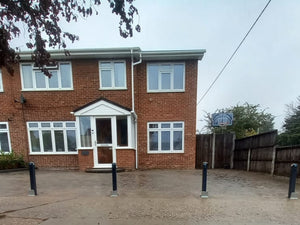
Short answer: if you own the freehold of your home and you are putting bollards on your own driveway, in almost every case you do not need planning permission. Standard driveway bollards stand 500–600mm high, well under the 1 metre limit that applies next to a road. You do need permission or consent if the bollard goes on or over the public highway, if the property is listed, if permitted development rights have been removed (an Article 4 direction in a conservation area), if the driveway is shared or leasehold, or if the bollard would stand more than 1 metre high at the roadside.
We are Bison Products of Swadlincote, Derbyshire. We have supplied and fitted security bollards since 1972 and we are one of the UK's largest bollard stockists. Our fitters install on driveways across the UK every week, so this is the answer we give on the phone — written down, with the actual rules and where they come from. It is general guidance, not legal advice: your local planning authority (LPA) has the final say.
The rule in plain English
In England, bollards on a driveway are normally treated as a "gate, fence, wall or other means of enclosure" under Schedule 2, Part 2, Class A of the Town and Country Planning (General Permitted Development) (England) Order 2015. That class gives you planning permission automatically — "permitted development" — as long as you stay inside these limits:
- 1 metre maximum where the bollard is next to a highway used by vehicles (that includes the footpath of such a highway) — so the front of virtually every driveway.
- 2 metres maximum anywhere else on the plot, for example a side or rear boundary.
- Not within the curtilage of a listed building — Class A never covers that.
- You are not making an existing enclosure taller than it already was, above those limits.
Height is measured above ground level. Here is how our most popular models compare with the 1 metre roadside limit:
| Bollard | Height above ground | Inside the 1m roadside limit? |
|---|---|---|
| Ramco 70 telescopic | 540mm | Yes — 460mm of headroom |
| Ramco 100 telescopic | 540mm | Yes |
| Ramco 600 round telescopic | 600mm | Yes |
| Ramco fold-down | Under 1m | Yes |
| Ramco AutoGuard automatic | 600mm raised, flush when lowered | Yes on height — but see the automatic bollard note below |

So for a normal home, height is almost never the problem. What matters is where the bollard goes and what kind of land it stands on.
When you do and don't need permission
| Your situation | Planning permission? | What to do |
|---|---|---|
| Freehold house, bollard on your own driveway, under 1m, no special designation | No — permitted development | Go ahead. Keep a note of the height and position. |
| Bollard over 1m high at the roadside (or over 2m elsewhere) | Yes | Apply, or choose a lower bollard — every model we sell is well under 1m. |
| Listed building, or inside its curtilage | Yes — and listed building consent may also be needed | Speak to your council's conservation officer before ordering. |
| Conservation area, National Park, AONB or World Heritage Site | Usually no, but check | Class A still applies in these areas, but councils often use an Article 4 direction to remove permitted development rights. Check your council's Article 4 map. |
| On the pavement, verge or road outside your boundary | Not permitted at all without highway authority consent | See the public highway section below. Don't do it. |
| Shared or unadopted driveway, private right of way | Planning permission often not the issue — consent is | You need the agreement of everyone with a right of way. Blocking it can be actionable even where planning rules are satisfied. |
| Leasehold house or flat, or a managed estate | Landlord/freeholder or management company permission | Check the lease. Many require written consent for alterations to the demise. |
| Commercial site, car park or business premises | Usually no for bollards under 2m on your own land | Check for planning conditions on the original consent — car parking and boundary treatment conditions are common. |
| Automatic rising / retractable bollards | Grey area | See below. |
Every bollard we sell is under the 1 metre roadside limit — so on a normal freehold driveway you can go ahead. Get a fitted price in under a minute: postcode, model, quantity.
Get an instant fitted price or call 01283 215097Automatic and retractable bollards: the one real grey area
This is the part most articles miss. Class A covers a "means of enclosure", and a retractable bollard spends much of its life flush with the ground, enclosing nothing.
In appeal decision APP/P1940/X/21/3287314, a homeowner applied for a certificate of lawfulness for six automatic retractable bollards, about 500mm high, in a front garden. The Planning Inspector accepted that bollards are more like a fence or gate than, say, a garden ornament, but concluded that because they retract into the ground — and because there were large walkable gaps between them — they were not "sufficiently similar to gates, fences and walls" to count as an "other means of enclosure". The appeal was dismissed: those bollards were not permitted development, so they needed planning permission. The Inspector also noted that some local planning authorities do accept bollards under Part 2, and that the decision turned on the facts of that case.
What that means for you. A fixed or telescopic bollard that stands above ground when in use is on far safer ground than a fully retracting automatic one. If you are installing automatic rising bollards — especially in a front garden, in a conservation area, or anywhere the council takes a close interest — ask your LPA in writing first, or apply for a Lawful Development Certificate. A short email to the planning duty officer is free and settles it.
Bollards on the public highway or pavement
You cannot install bollards on the road, the verge or the pavement outside your house — not even to stop people blocking your drive. That is not a planning question, it is a highways one:
- Under section 137 of the Highways Act 1980 it is a criminal offence to wilfully obstruct the free passage of a highway without lawful authority. Since the Police, Crime, Sentencing and Courts Act 2022 the penalty can be an unlimited fine and/or imprisonment.
- Only the highway authority can place bollards on the highway, using powers such as section 66(2) of the Highways Act 1980 and Part VII of the Road Traffic Regulation Act 1984.
- Any excavation or structure in the highway needs the authority's licence, and a new vehicle crossing over a footway needs a dropped kerb approved under section 184 of the Highways Act 1980.
The practical point: check where your boundary actually is. Your title plan at HM Land Registry (£3 online) will tell you. Fit the bollard inside your own boundary and this issue disappears.
Scotland, Wales and Northern Ireland
The framework is the same idea, different orders. Wales applies broadly the same 1 metre and 2 metre limits under its own version of the GPDO. In Scotland, gates, fences, walls and other means of enclosure are covered by the Town and Country Planning (General Permitted Development) (Scotland) Order 1992, with a 2 metre overall limit and tighter rules where the enclosure fronts a road. Northern Ireland has an equivalent Class A in its 2015 Order. Standard driveway bollards sit comfortably inside all of them, but if your property is listed or in a designated area, check locally.
How to check your own case in ten minutes
- Do you own the freehold? If you are a leaseholder or on a managed estate, get written consent from the freeholder or management company first.
- Is the bollard entirely inside your boundary? Compare the position with your Land Registry title plan.
- Is the property listed, or in the curtilage of a listed building? Search Historic England's National Heritage List.
- Is it in a conservation area, and is there an Article 4 direction? Your council's planning pages will have both maps.
- Any planning conditions or deed covenants? Conditions on a newer estate and restrictive covenants in the deeds catch people out far more often than planning rules do.
- Still unsure, or fitting automatic bollards? Email the planning duty officer with a photo and the bollard spec, or apply for a Lawful Development Certificate.
What it costs if you do need an application
In England, from 1 April 2026, the householder fee for "the erection or construction of gates, fences, walls or other means of enclosure" along the boundary of an existing house is £272. Other householder alterations are £548. Pre-application advice from your council is usually charged separately, and a Lawful Development Certificate application has its own fee. Fees change annually — check the current Planning Portal fee schedule before you pay.
What happens if you install without permission
If permission was needed and you didn't get it, the council can serve an enforcement notice requiring the bollards to be removed, at your cost. Since 25 April 2024 the enforcement window in England for unauthorised building works is ten years from substantial completion, not the old four. That is a long time to be exposed — which is why a free email to the planning department beforehand is worth the ten minutes.
Frequently asked questions
Do you need planning permission for bollards on a private driveway?
In almost all cases, no. On your own freehold land, bollards up to 1 metre high next to a road (2 metres elsewhere) are permitted development under Class A, Part 2 of the GPDO 2015. Standard driveway bollards are 500–600mm, so they fall well inside the limit. Permission is needed for listed buildings, where an Article 4 direction applies, or on the public highway.
How high can a bollard be without planning permission?
1 metre above ground level where it is next to a highway used by vehicles, including that highway's footpath. Elsewhere on your land, 2 metres. Anything taller needs an application.
Do I need permission for bollards in a conservation area?
Class A permitted development still applies in conservation areas, so usually not — but many councils have an Article 4 direction that removes those rights, and the design may need to suit the street. Check your council's Article 4 map before ordering.
Can I put bollards outside my house on the pavement or road?
No. Obstructing a highway without lawful authority is an offence under section 137 of the Highways Act 1980. Only the highway authority can place bollards there. Anything you install must sit inside your own boundary.
Do automatic rising bollards need planning permission?
Possibly. In appeal APP/P1940/X/21/3287314 the Planning Inspectorate found that retractable bollards were not an "other means of enclosure" and so were not permitted development, because they sink flush with the ground. Some councils accept them under Part 2. Ask your local planning authority in writing, or apply for a Lawful Development Certificate.
Do I need planning permission for bollards on a shared driveway?
Planning permission usually isn't the obstacle — consent is. If others hold a right of way over the driveway, you need their agreement; blocking a right of way can be actionable regardless of planning rules. Leaseholders also need the freeholder's permission.
Do commercial bollards need planning permission?
Bollards under 2 metres on your own commercial land are generally permitted development. Check for planning conditions attached to the site's original consent, and remember that anything on or overhanging the public highway needs highway authority consent.
Do bollards need building regulations approval?
No. Fences, walls and gates — and bollards with them — do not require building regulations approval. Sensible siting still matters: keep sightlines clear at the entrance.
Need a hand?
We fit bollards on driveways across the UK, so we see the planning question every week. Tell us where the driveway is and what you want to stop, and we will tell you straight whether you have anything to worry about.
Not sure whether your driveway is the straightforward case or one of the exceptions? Tell us the postcode and we will tell you straight.
Get an instant fitted price or call 01283 215097- Driveway bollards: which type do you need?
- How much do driveway bollards cost?
- Shop telescopic driveway bollards
- Or call us on 01283 215097.
Last reviewed: 8 September 2026. General guidance for the UK, not legal advice — your local planning authority decides. Sources: Town and Country Planning (General Permitted Development) (England) Order 2015 Sch. 2 Pt. 2 Class A; Planning Portal, "Fences, gates and garden walls"; Highways Act 1980 ss. 66, 137, 184; Road Traffic Regulation Act 1984 Pt. VII; Planning Inspectorate appeal APP/P1940/X/21/3287314; Levelling-up and Regeneration Act 2023 s. 115; Planning Portal England application fees, 1 April 2026.